
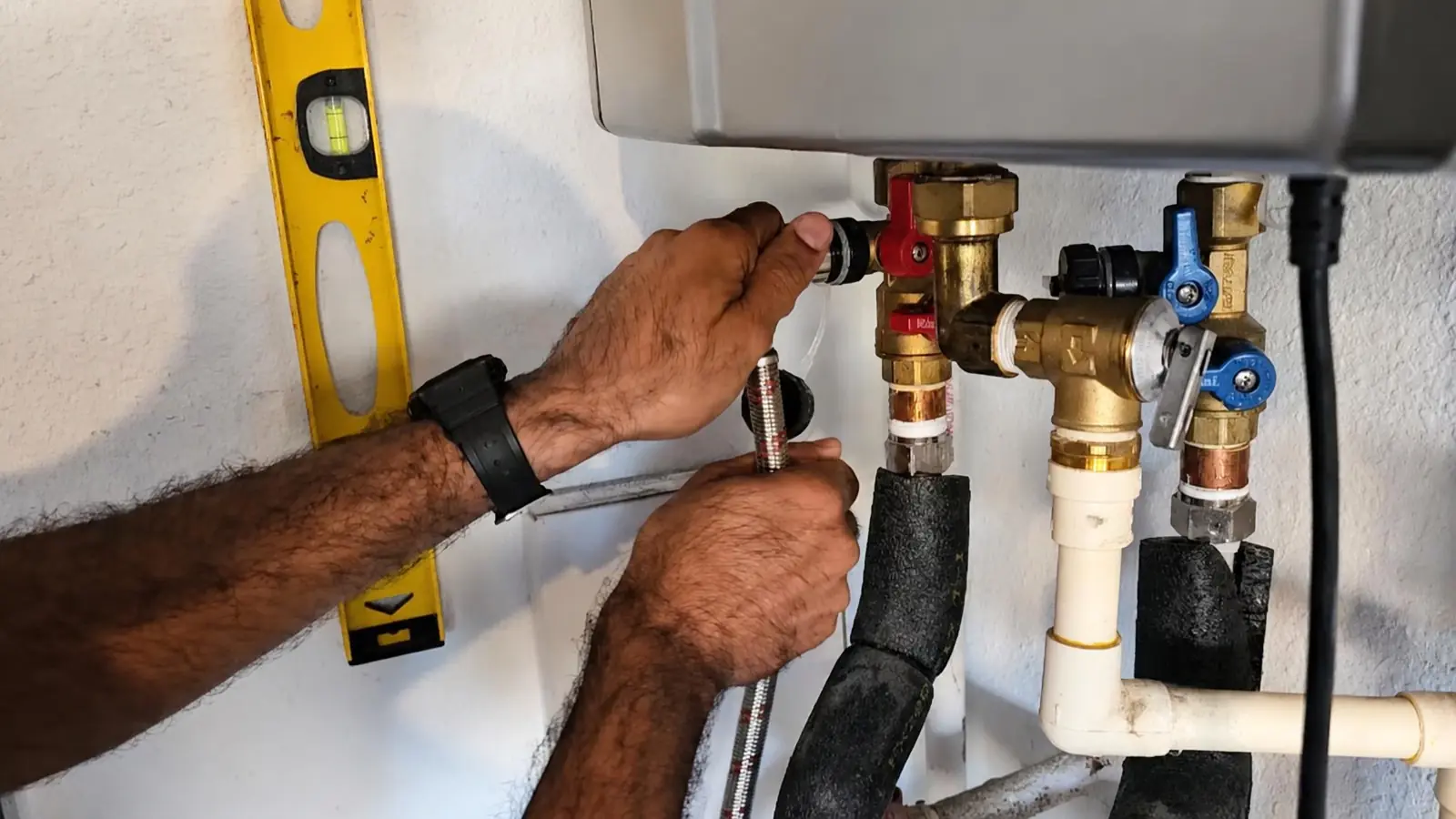
A tankless hot water heater, also called an on-demand heater, heats water only when you open a hot tap. Cold water enters the unit, a burner or electric elements warm it as it passes through a heat exchanger, and hot water leaves within seconds. There is no storage tank, which is why the unit is small enough to hang on a wall.
The trade-off is flow rate. A tankless unit can only heat so many gallons per minute, so sizing matters. If you are in Montclair and weighing a new heater, this guide explains the choices.
How it works inside
A flow sensor detects water moving. It signals the burner or elements to turn on, and a temperature sensor adjusts the output to hold the setpoint. When you close the tap, the unit shuts off. Gas units also need a vent for exhaust, while electric units need a heavy electrical circuit.
Tankless compared with a tank
| Factor | Tankless | Tank |
|---|---|---|
| Hot water | Continuous up to its flow limit | Large reserve then recovery |
| Size | Wall mounted | Floor standing |
| Installation | May need gas, venting or electrical upgrades | Often a simple swap |
| Maintenance | Descaling in hard water | Flushing and anode checks |
| Cost upfront | Higher | Lower |
What it takes to install one
Most gas tankless units need a larger gas pipe than a tank. Venting is different too, because exhaust is hotter or sealed. Electric units can need a dedicated high amperage circuit, which sometimes means a panel upgrade.
This is why we look at the house before recommending one. See our tankless water heater page for how we handle installation and service.
Tankless in Montclair houses
Older Montclair basements often have an old chimney or a tight utility corner, and either affects venting. Montclair publishes an annual water quality report that lists hardness, so you can see whether scale is likely to be an issue for a tankless heat exchanger. If the water is hard, plan on yearly descaling.
Who tankless suits
- Homes with limited space where a tank would be in the way.
- Households that want to avoid a tank failing in a finished basement.
- Homes with the right gas or electrical capacity.
- Owners who will keep up with yearly descaling.
Sizing a tankless heater
Tankless sizing comes down to flow rate and temperature rise. Flow rate is how many gallons per minute you need at once, and temperature rise is how much the unit must warm the incoming water. A shower uses roughly two gallons per minute, a kitchen faucet a bit less and a washing machine or dishwasher adds more.
Add up the fixtures that may run together at your busiest time. A household that showers and runs the dishwasher at the same time needs a bigger unit than one that stagger their use. Winter incoming water is colder, so size for the cold months.
Questions to ask before you buy
A good answer comes with numbers and a plan, not a brochure. We are glad to give you both for your house.
- What is the unit rated for at my incoming water temperature?
- Does my gas line or electrical panel need an upgrade?
- How will it vent and where does the exhaust go?
- What maintenance does the maker require to keep the warranty?
- Who services it if something fails?
Running costs and upkeep
Tankless units avoid the standby heat loss of a tank, which can lower energy use in homes with moderate hot water demand. Savings shrink in households that use a lot of hot water at once, so the bill depends on how you live.
Plan on yearly descaling in hard water areas. Scale builds inside the heat exchanger and cuts flow and efficiency. A flush with vinegar or a descaling solution, done by a plumber or by you if the maker allows it, keeps the unit working.
Retrofit surprises in older homes
Older Montclair houses may have gas lines sized for a tank heater, flues that do not suit a high efficiency unit or panels with no spare capacity for an electric model. These are the usual reasons a tankless quote is higher than the unit price suggests.
Ask for the full scope in writing, including venting, gas line, condensate drain and any permit. See tankless water heater service for how we handle these jobs.
Is tankless right for your home
It suits households that want endless hot water and have the space, gas and venting to support it. It is harder to justify when a simple tank swap would do the job for far less. Weigh your habits, your budget and how long you plan to stay.
Codes and standards behind the work
Gas tankless units are listed to ANSI Z21.10.3 and must be vented as the manufacturer and the National Fuel Gas Code (NFPA 54) require.
Next steps
If your current tank is failing, see water heater installation for the options. We serve Montclair and Glen Ridge, and the service area page lists nearby towns.
Tankless questions
It is continuous up to its flow limit. Running several fixtures at once can exceed what one unit makes.
Often yes. Many tankless gas units draw more gas than a tank, so we check your line.
Scale builds up on the heat exchanger. Regular descaling and a softener help.
Read the township water quality report for hardness, then decide with a plumber.
A simple swap may be a day. Gas or venting changes add time.