
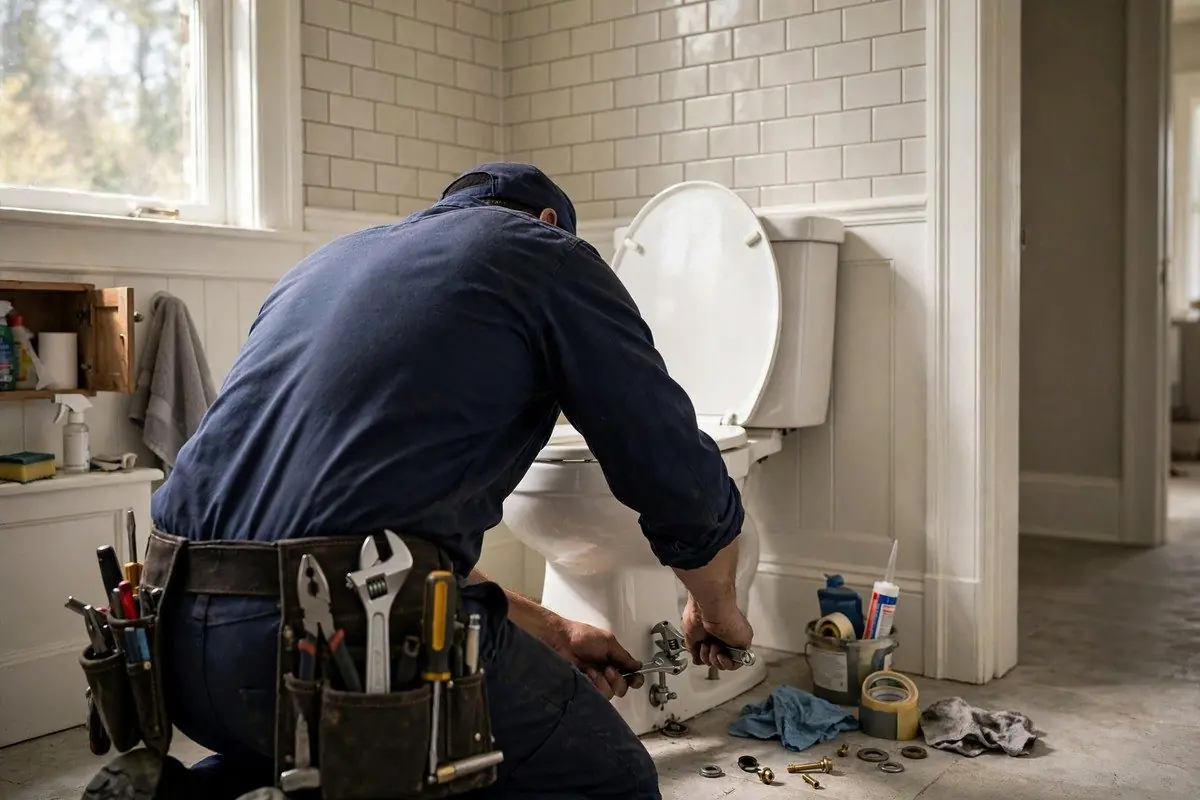
A toilet clogged with toilet paper is one of the most common plumbing calls, and many are solved with a plunger in a few minutes. Paper clogs form when too much paper meets a slow trap or a partly blocked drain. If the water level drops after plunging and the toilet flushes normally, you are done.
If the bowl keeps rising, or other drains gurgle, stop. That pattern points to a deeper clog, and pushing harder will not help. Call (973) 488-5410 and tell dispatch which fixtures are affected.
Stop the overflow first
Before plunging, protect the floor. Lift the tank lid and push the flapper down to stop more water from entering. Then turn the shutoff valve behind the toilet clockwise until it stops.
- Stop the flow. Close the flapper or the shutoff valve.
- Use the right plunger. A flange plunger with an extra rubber lip seals better in a toilet than a flat one.
- Plunge steadily. Seal the bowl and push and pull for 15 to 20 seconds.
- Wait before flushing. Watch whether the water drains. Do not flush until it does.
What not to do
Chemical drain openers rarely work on toilets and can damage porcelain seals or injure whoever services the line next. Flushing repeatedly can send water over the rim. Never put your hand into a drain opened by chemicals.
Hot water, not boiling, with a squirt of dish soap helps loosen paper in some cases. Boiling water can crack porcelain.
Plunger or plumber?
| What you see | What it suggests | What to do |
|---|---|---|
| Clears after plunging | A paper clog in the trap | Done, flush less paper next time |
| Clears but returns the same day | A partial clog deeper in the line | Call for an auger |
| Other fixtures gurgle or slow | Branch or main line clog | Call, and see drain cleaning |
| Water backs up in the tub or basement | Main line blockage | Stop water and call |
Why this clog shows up in older Montclair houses
Many Montclair houses date to the early 1900s, and older drains are rougher inside than modern pipe. Paper and scale catch on that surface, so a house with a slow second floor toilet is often dealing with a stack or branch line, not only the bowl. If your toilet clogs on a regular basis, a camera look at the line tells you why.
Keeping paper clogs from coming back
- Use less toilet paper per flush, or flush twice.
- Keep wipes, even labeled flushable ones, out of the toilet.
- Check that the tank fills to the right level.
- Have the drain checked if the toilet clogs more than a few times a year.
How much paper is too much
Toilet paper is designed to break down, but a thick wad can hold together in a slow trap. Using a little less per flush, or flushing twice for a heavy load, prevents most paper clogs. Households with children or guests often see the most trouble because of how much paper goes in at once.
Ultra thick and quilted papers are the usual offenders. They feel soft but take longer to disperse, so a toilet that handled the old brand without trouble may clog with the new one.
Using a toilet auger
If plunging fails, a toilet auger is the next tool. It has a curved guide that protects the porcelain while a cable reaches into the trap. Feed it in gently, turn the handle as you push and pull back slowly so the clog comes with it.
Stop if the cable stops against something that does not move. Forcing it can scratch the bowl or push the clog deeper. At that point a plumber can use a camera or a larger machine.
When the clog is not in the toilet
A toilet that clogs again right away, or one that gurgles when you run the shower, points past the bowl. A blockage in the branch line or the main will keep sending water back no matter how often you plunge. Plunging harder only wastes time and risks a spill.
We run a camera when the pattern points to the line. If it finds roots, scale or a belly, we explain the fix and the price before starting. See toilet repair for what we do when the problem is the toilet itself.
Codes and standards behind the work
Toilets sold in the United States are limited to 1.6 gallons per flush by federal rules, and many hold 1.28 gallons, which is why a weak flush clogs more easily than an older model.
Where to call
We handle clogged toilets across Montclair and in Glen Ridge. The service area page lists the towns we cover. Call (973) 488-5410 for dispatch.
Toilet clog questions
It breaks down in water over time, but a thick wad can hold together long enough to block a trap.
A toilet auger is designed for it. A regular drain snake can scratch porcelain.
Older cast iron and clay lines are rougher inside and clog more often. A camera inspection can show if the line needs work.
When water is rising to the rim or other fixtures are backing up, stop using water and call.
We advise against it. Chemicals rarely clear a toilet and put the next person at risk.