
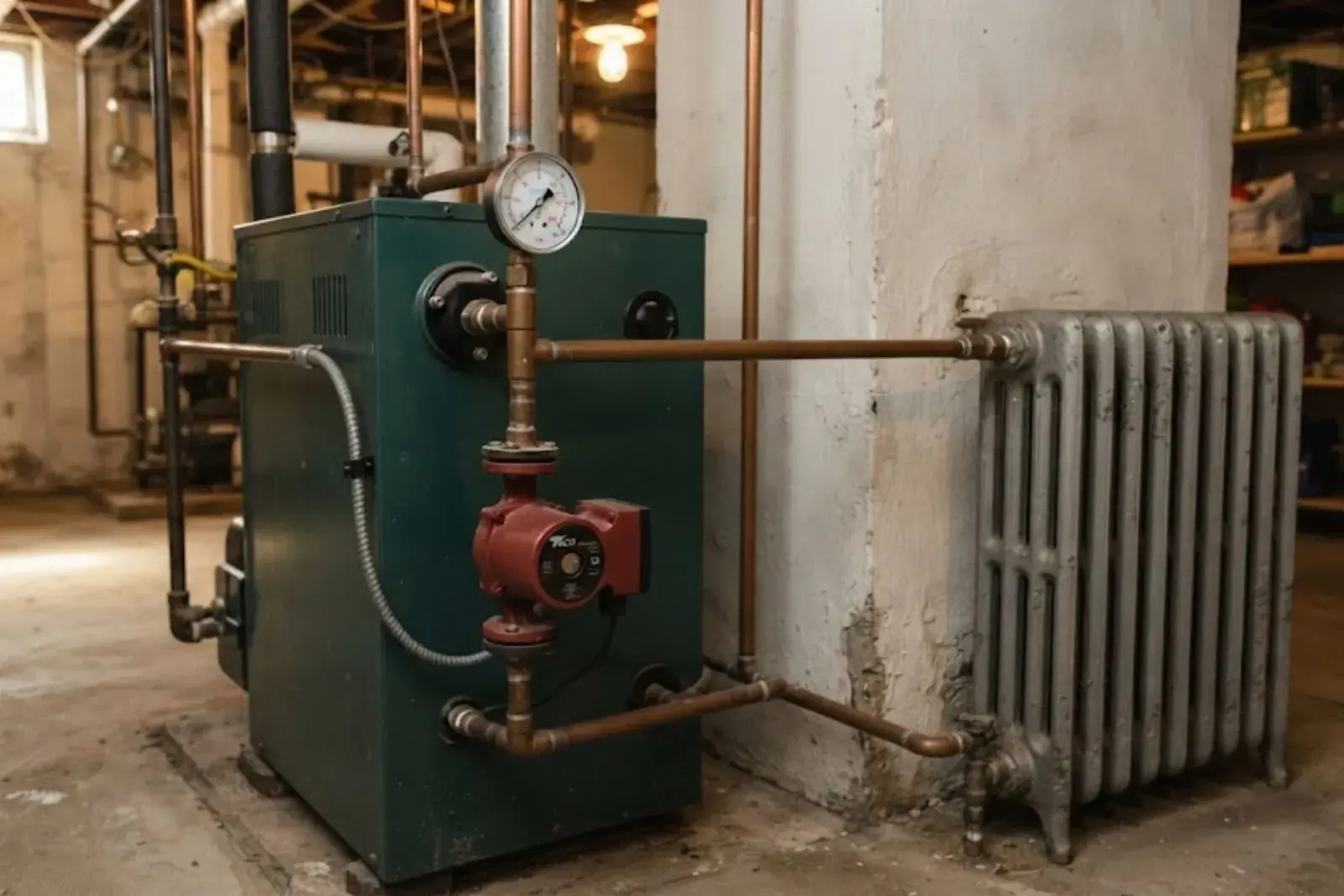
A hot water boiler heats water and sends it through pipes to radiators or baseboards. It is a simple system that runs for decades when it is maintained, and it fails at the worst time when it is not. A yearly service before the heating season is the best way to avoid a no heat call in January.
This guide lists what maintenance covers, the common repairs and the signs that mean you should call. If you need help now, call (973) 488-5410.
What a yearly service covers
- Pressure and the relief valve.
- The circulator pump and the expansion tank.
- Burner or igniter cleaning and testing.
- Venting, combustion air and carbon monoxide readings.
- Radiators and zone valves for leaks and air.
Common boiler faults
| Symptom | Likely cause | Typical repair |
|---|---|---|
| No heat | Pump, thermostat or ignition fault | Test and replace the part |
| Cold radiators | Trapped air or a failed zone valve | Bleed or replace the valve |
| Pressure drops | A leak or a failed expansion tank | Find the leak and test the tank |
| Banging noises | Sediment or poor flow | Flush and check the pump |
| Frequent restarts | Dirty burner or a failing sensor | Clean and test |
Simple things you can do
Check the pressure gauge once a month in winter. Most residential boilers sit in a modest range, and the right number is on the label or in the manual. If the needle is at zero or very high, call us before adding water or opening valves.
Bleeding a radiator removes trapped air. Open the small valve at the top with a key until water appears, then close it. If the radiator fills with air again within days, the system has a leak or a pump problem.
Montclair homes and their boilers
Many Montclair houses were designed around a boiler and radiators, and some systems have original piping with newer equipment. Winters in the area can bring long cold stretches, so a system that is not serviced is more likely to fail when it is needed. If your house still has the original distribution system, ask a plumber to check pipe condition during the service.
Carbon monoxide and safety
Fuel burning boilers can produce carbon monoxide if venting fails. Working detectors on every floor are essential. A yellow flame, soot near the boiler or a smell of gas means the unit needs a technician right away.
If a detector sounds, leave the house and call 911. Do not return until the building is cleared.
Radiators and zones
Radiators heat by hot water flowing through them, and each one needs a path for the water and a way to release air. If one radiator is cold while others are hot, the cause is usually air or a stuck valve on that radiator. If a whole floor is cold, a zone valve or a thermostat may be at fault.
Keep furniture and curtains away from radiators so heat can circulate. Do not close more than a few valves at a time, because that can unbalance the system and strain the pump.
What to ask for in a service visit
A visit that includes these steps tells you the condition of the system before the cold arrives. Book it early in the fall, when schedules are open.
- Combustion readings and a carbon monoxide check.
- A look at pressure, the relief valve and the expansion tank.
- Inspection of venting and combustion air.
- Cleaning or testing of the burner and igniter.
- A clear report of what was checked and what needs follow up.
Signs your boiler needs attention now
Banging, whistling, puddles under the unit, a pilot that keeps going out and uneven heating are all signs. Pressure that drops over days points to a leak, and pressure that climbs points to a faulty expansion tank or feed valve.
Turn the boiler off and call if you smell gas or see soot around it. Do not keep resetting a unit that locks out, because repeated resets can hide a safety fault.
Efficiency and when to replace
An old boiler can keep running for decades, but efficiency falls with age. If repair bills are climbing, parts are hard to find or the unit short cycles, a replacement quote is worth requesting. Compare it with the repair cost and the fuel savings over several winters.
Ask about sizing. A boiler that is too large cycles often, wastes fuel and wears out sooner, and an undersized one never catches up on cold days.
Codes and standards behind the work
Venting and gas piping for boilers are covered by the National Fuel Gas Code (NFPA 54), which is one reason a combustion check belongs in every service visit.
When to call
Call for no heat, falling pressure, leaks or noises that are new. See boiler repair for what we do. If a hot water tank is part of the problem, see water heater repair. We serve Montclair and Glen Ridge, and the service area page lists nearby towns.
Boiler questions
Yearly, before the heating season, is the usual recommendation.
Air is trapped. Bleeding the radiator usually fixes it.
The label or manual gives the range. Call if it is outside that range.
It can mean sediment or poor flow. Have it checked before it causes damage.
Long cold stretches put the system under heavy use, so service before the heating season.